12 May - 27 Sep 2026

La mar èpica

"La mar èpica: els almadravers de Benidorm a les fotografies de Jesús Navarro"
Una exposición sobre el vínculo del hombre con el mar, un lazo tan antiguo como la misma humanidad

A través del extraordinario archivo fotográfico del pionero de la fotografía submarina y del buceo autónomo Jesús Navarro, realizado entre 1959 y 1969, la exposición nos recupera un mundo ya desaparecido lleno de monstruos marinos: nos encontramos ante algunas de las primeras fotografías submarinas de la historia de todo el estado.

Por otro lado, nos presenta a la almadraba: un universo acuático —tan fascinante como hostil— de sal, arena, hierro, madera y sangre. Este antiguo arte de pesca del atún rojo entronca con una tradición atlántica y mediterránea de casi tres mil años de antigüedad que, en los últimos 700, tuvo como indiscutible figura de autoridad a los valencianos y, en concreto, a los capitanes de almadraba, o arráeces, de Benidorm. Su maestría y pericia, una sabiduría acumulada durante generaciones y transmitida con orgullo de padres a hijos, los acreditó durante siglos como los mejores en un oficio tan complejo y colosal como es la almadraba.

A través de los testimonios directos de algunos de los protagonistas de las imágenes, recogidos durante dieciocho años por el comisario de la exposición, así como de los textos del mismo Jesús Navarro publicados en la revista Cris, revista del mar, podemos revivir muchas anécdotas sobre las vidas de unos hombres y mujeres que durante seis meses abandonaban sus hogares por necesidad, en éxodo anual, para embarcarse en una aventura incierta en el sur lejano.

Disciplinas como la historia, la etnografía, la antropología, la filología, la biología, la oceanografía, la ecología e incluso la numismática sobrevuelan el proyecto, completando su contenido y  dotándolo de rigor científico. La tarea de recuperación de la memoria oral se ha realizado in extremis, a punto de desaparecer para siempre, pues la mayoría de sus protagonistas han muerto desde que empezó el proyecto en 2007.

Jesús Navarro se convirtió en testigo privilegiado de un punto de inflexión en la historia: el cambio de paradigma de una mar épica a una mar domesticada, indolente y mansa que transformó a los habitantes de Benidorm.

La próxima vez que alguien mal informado se refiera al Benidorm antiguo como un «pueblecito de pescadores», habrá que matizarle las palabras y La mar èpica. Els almadravers de Benidorm a les fotografies de Jesús Navarro, nos ayudará a sacarlo de su error. Aunque, si queremos ser indulgentes podremos decirle que sí, ¡pero pescadores de pescados grandes!

12 May - 27 Sep 2026
Comisariada por:

Jaume Fuster

11 Mar - 27 Sep 2026

L'or roig

The exhibition offers a visual overview of the history of saffron production through the David Beltrà Collection, highlighting the brands, families, and trade routes that shaped the Saffron Route.

Expo "L'or roig"Saffron, introduced to the Iberian Peninsula by the Arabs, became established as an essential spice in Valencian cuisine and as a valuable commodity in Mediterranean trade. Beyond its culinary value, its production has constituted an ethnological phenomenon: an agricultural cycle marked by the calendar, harvesting at dawn, and traditional know-how passed down from generation to generation. It is meticulous work—up to 200,000 flowers are required to produce a single kilogram—reflecting farming communities, rhythms of life, and identity.

In the nineteenth and twentieth centuries, a distinctive trade route took shape. While many spices travelled from East to West, saffron from this region followed the opposite route to India, China, Japan, and the Americas. This flow projected the aroma and prestige of Spanish saffron worldwide, as well as the role of the merchants and warehouses of the Vinalopó region. Today, century-old companies in Novelda continue to lead this global trade, heirs to a tradition that combines industry, family, and territory.

The David Beltrà Collection invites visitors to explore this history visually: brands, lineages, and routes that make the Saffron Route visible—a narrative in which material culture, the memory of labour, and a Valencian way of understanding the world intertwine.


11 Mar - 27 Sep 2026
19 Sep - 21 Sep 2025
FAIR

ETNOPOBLES 2025

II FAIR OF LOCAL ETHNOLOGICAL MUSEUMS

ETNOPOBLES is a local museum fair that aims to showcase the cultural activities of these museums to the citizens of Valencia, and by extension, the cultural activities and events characteristic of each municipality.

On the one hand, there are stands corresponding to each of the museums (22 stands) where each museum offers information about its activities.  On the other hand, the FAIR will feature a rich programme of activities proposed by each museum/municipality. The FAIR will include workshops, presentations, conferences, exhibitions, cooking demonstrations, wine tastings, etc., with a total of 30 activities throughout the week.

The FAIR is aimed at families on Saturday and Sunday. On Friday 19 September, schools from the Carme neighbourhood and children from the Carme Neighbourhood Fallas Association are expected to attend.

PARTICIPANTS:

20 museums in the province of València: 


GUEST MUSEUMS

1 museum in the province of Castellón:


1 museum in the province of Alicante: 


19 Sep - 21 Sep 2025

ALL AUDIENCES ACTIVITIES. FREE ACCESS UNTIL FULL STANDING 
Except for some activities for adults and others where tickets are required. Consult programme

ESTANDS TIMETABLES 
Friday and Saturday: from 10 am to 2 pm and from 4 pm to 8 pm. 
Sunday: from 10 a.m. to 2 p.m. 

16 May 2024 - 18:30 - 20:00

Presentation of the 24th Bernat Capó Award

El seculòrum i la seculera: contes i acudits llicenciosos valencians de tradició oral de Joan-Lluís Monjo i Mascaró.
The autor will be accompanied by: Joan Seguí, director of L’ETNO, i Núria Sendra, from Edicions del Bullent.

EL SECULÒRUM I LA SECULERA. Contes i acudits llicenciosos valencians de tradició oral.

A work dedicated to the Valencian narrative folklore that is linked to the expression of sex. Its main objective is to highlight the value of a subgenre that, although it still has a certain validity in the oral tradition, in the Valencian context, unlike in other territories, has not been compiled and studied in a monographic way until now.

It supposes a contribution to the Valencian rondallística, offering, on the one hand, an anthology of a hundred stories and songs compiled from the oral tradition. It is the result of a field work carried out in different towns both in the Valencian and Castilian linguistic area. There is a sensitization to reproduce the oral materials through reliable transcriptions so that they have validity both as ethnographic documents and as testimonies of a linguistic patrimony.

On the other hand, the work offers an introductory study to understand aspects related to the stories as literary texts, such as the humoristic resources on which they are based, or referring to their context, for example, the sources and the fields in which they are disseminated. Likewise, the study proposes a classification of the materials according to the index of rondallistic types The Types of International Folktales.

The author will be accompanied by:

  • Joan Seguí, director of L'ETNO
  • Núria Sendra, from Edicions del Bullent.

16 May 2024 - 18:30 - 20:00

Actividad gratuita

16 May 2024 - 18:30 - 20:00

Presentation of the 24th Bernat Capó Award

EL SECULÒRUM I LA SECULERA. Contes i acudits llicenciosos valencians de tradició oral.

A work dedicated to the Valencian narrative folklore that is linked to the expression of sex. Its main objective is to highlight the value of a subgenre that, although it still has a certain validity in the oral tradition, in the Valencian context, unlike in other territories, has not been compiled and studied in a monographic way until now.

It supposes a contribution to the Valencian rondallística, offering, on the one hand, an anthology of a hundred stories and songs compiled from the oral tradition. It is the result of a field work carried out in different towns both in the Valencian and Castilian linguistic area. There is a sensitization to reproduce the oral materials through reliable transcriptions so that they have validity both as ethnographic documents and as testimonies of a linguistic patrimony.

On the other hand, the work offers an introductory study to understand aspects related to the stories as literary texts, such as the humoristic resources on which they are based, or referring to their context, for example, the sources and the fields in which they are disseminated. Likewise, the study proposes a classification of the materials according to the index of rondallistic types The Types of International Folktales.

The author will be accompanied by:

  • Joan Seguí, director of L'ETNO
  • Núria Sendra, from Edicions del Bullent.
16 May 2024 - 18:30 - 20:00

Free activity

06 Jun - 07 Jun 2024
Workshops

Sustainability, museums and cultural heritage

In 2015, the United Nations General Assembly adopted the 2030 Agenda and the Sustainable Development Goals (SDGs) in order to "set the world on a path of sustainability and resilience". The proposed goals are based on three pillars: economic growth, social development and environmental protection, as established at the World Summit on Sustainable Development in 2002.

Culture, however, "a source of meaning and energy, of creativity and innovation, and a resource for responding to challenges and finding appropriate solutions", as defined by UNESCO in 2013 in its Hangzhou Declaration: placing culture at the heart of sustainable development policies, has not been considered a necessary pillar. This absence of culture in the SDGs has been criticized by different institutions as shown by the #culture2030goal campaign.

Thus, these days have a dual purpose. On the one hand, to show and demonstrate the need to incorporate culture in the goals and targets on sustainability. And, on the other hand, to highlight the role of museums and heritage infrastructures in promoting and boosting sustainability and cultural vitality in the territory.

06 Jun - 07 Jun 2024
Location:

L'ETNO permanent exhibition room

18 Dec 2023 - 23:00
Press release

Treasures with history II

In this exhibition you can see objects from the second and third seasons of the programme.

Treasures with history is a programme that the Valencian Public Television À Punt has been broadcasting successfully for the last three seasons. It deals with the objects that people keep as precious material, as an emotional treasure full of experiences and memories. It is a well-known fact that objects have the capacity to establish emotional connections with people, and the complexity of this relationship is the subject of Treasures with history. L'ETNO now brings you closer to this universe of objects that from history, ethnology or art have built part of our memory as a people over the last 200 years. 

Produced in collaboration with the Valencian Institute of Culture, Treasures with History 2 is an exhibition organised by L'ETNO to show the public the more than one hundred treasures selected for the programme.

Related content
Related content
24 Feb 2022 - 17:00 - 19:00
COMBOI I ANTROPOLOGIA

Subjectes diversos

Conferència: Subjectes diversos. Investigació antropològica i Diversitat Funcional 

Subjectes diversos és una invitació a repensar la pròpia categoria de subjecte antropològic mitjançant una conversa a tres de les antropòlogues Raquel Sánchez Padilla, Ángela Calero Valverde i Teresa Vicente Rabanaque que formen part del grup d'investigació "DIVERSITATS. Antropologia i Diversitat Funcional". La idea és recordar i reviure les aventures i desventures que les tres investigadores han experimentat al llarg dels anys investigant la Diversitat Funcional com a categoria social.

Les tres investigadores formen part de l'equip multidisciplinari Diversitats. Antropologia i Diversitat Funcional, que té com a objectiu principal estudiar la diversitat funcional com a categoria social, que naix després d'una trajectòria de col·laboració en diversos projectes i contractes d'investigació relacionats amb l'accessibilitat, l'oci inclusiu i la diversitat funcional.

En col·laboració amb AVA (Associació Valenciana d'Antropologia).

24 Feb 2022 - 17:00 - 19:00

Activitat gratuïta

03 Feb 2024 - 18:30 - 22:30
Storytelling Festival

8th Al caliu de les paraules

We are back for another year with "Al caliu de les paraules", the eighth edition !!!! This year we will reflect on narratives from a female perspective.

It is a well-known fact that women have always told stories. They have been the ones who have preserved the living memory of the oral tradition the most and the best. They have been the ones who have most and best preserved the living memory of the oral tradition. And they have done so in the domestic sphere, accompanying the tasks of caring for, feeding and entertaining their loved ones, with the spoken and sung word, recreating the word-caress, or the word that provokes curiosity and restlessness. 

They have also done so, outside the home, by conversing or encouraging collective agricultural and livestock tasks. There were many propitious moments throughout the day to allow the living word to be spoken, together with the gaze that crosses centuries and plunges into distant lands. It was so common for women to tell stories that the expression "old wives' tales" was coined. 

But women have not limited themselves to telling stories in the intimacy of the home or in the workplace. They have been and are the undisputed protagonists of the survival and revitalisation of the spoken word in all areas of life. Thanks to them, this art, this treasure, this craft of storytelling remains alive. 
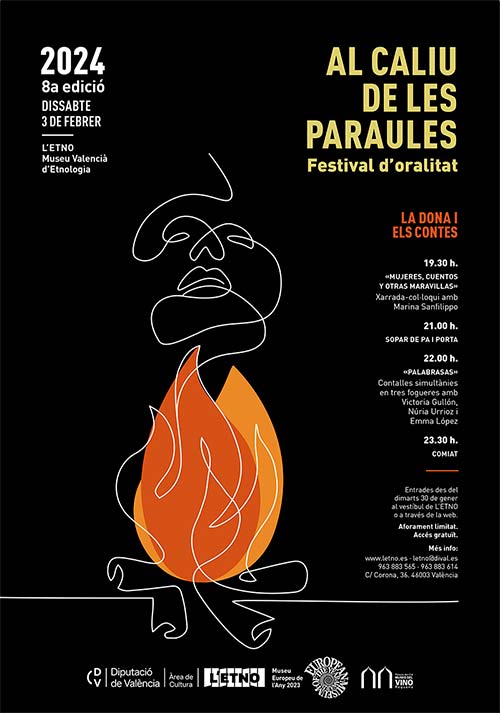
From AL CALIU DE LES PARAULES we will pay special attention to the role that women have played in the creation of tales and stories. We will do so with Marina Sanfilippo, an expert in artistic and popular orality, and with Victoria Gullón, Nuria Urrioz and Emma López, three great storytellers who in this eighth edition will accompany us to enjoy stories, romances and songs in the heat of the bonfires, and of course, of words, the living memory of the oral tradition. And they have done so on the domestic stage, accompanying the tasks of caring for, feeding and entertaining their loved ones, with the word told and sung, recreating the word-caress, or the word that provokes curiosity and restlessness. 

They have also done so, outside the home, by conversing or encouraging collective agricultural and livestock tasks. There were many propitious moments throughout the day to allow the living word to be spoken, together with the gaze that crosses centuries and plunges into distant lands. It was so common for women to tell stories that the expression "old wives' tales" was coined. 

But women have not limited themselves to telling stories in the intimacy of the home or in the workplace. They have been and are the undisputed protagonists of the survival and revitalisation of the spoken word in all areas of life. Thanks to them, this art, this treasure, this craft of storytelling remains alive. 

LETNO_caliu de les paraules


PROGRAMME

Saturday, 3rd February

19.30 h. "Women, stories and other wonders". 

Talk-colloquium with Marina Sanfilippo, coordinator of the Permanent Seminar on Literature and Women at the Faculty of Philology of the UNED and member of the Chair of European Intangible Cultural Heritage (University of Valladolid).

21.00 h. Dinner of "sobaquillo" 

Dinner at three bonfires with riddles and toasts. 
"sobaquillo" means that participants should bring their own supper and the organisation will provide the snacks and drinks. 

22.00 h. "Palabrasas" (Words)

Simultaneous storytelling at three bonfires. 

23.30 h. Farewell 

Joint celebration with dancing and singing.

Storytellers:

Victoria Gullón (romances), Nuria Urrioz and Emma López.

Idea, project and coordination:

Vicente Cortés -Vividor del cuento.

Imatges
03 Feb 2024 - 18:30 - 22:30
Accés i recollida d'entrades

Limited seating. Free admission with ticket. Collection from Tuesday 30 January 2024 (maximum 2 tickets per person) in the foyer of L'ETNO (from 10 a.m. to 8 p.m.) or via this website.

Important note: before booking tickets through the online ticket platform you must register if you are not already a user.

Link to registration.